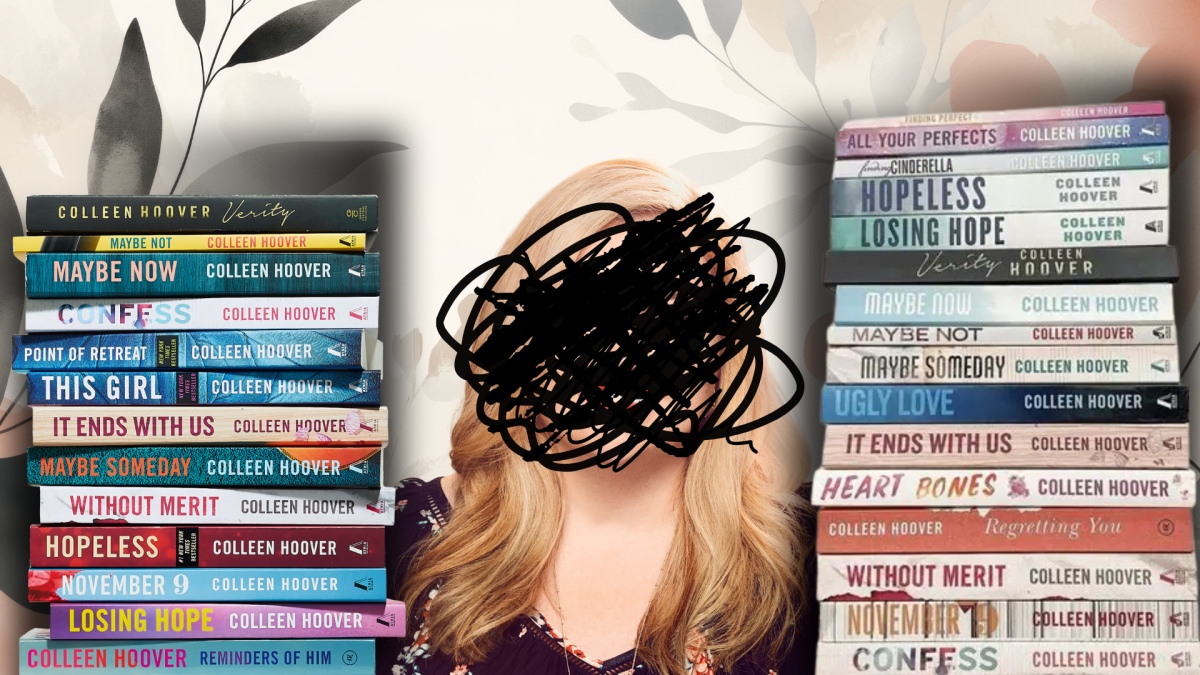
Margret Colleen Hoover is an author who gained popularity through publishing romance novels that went viral on social media platforms like Tik Tok and Instagram. In 2023 she was named one of Time magazine’s most influential people and has now sold over 20 million books. Suffice to say, she’s made a huge impact on the romance novel industry, but her acclaim isn’t earned.
Hoover has published 26 books as of 2026, including many that are called young adult (YA) novels, despite their content. One of her most popular novels, “Verity,” is considered a YA novel, which is classified as a book for 12-18 year old readers. Despite this rating, “Verity” is filled with content inappropriate for younger readers, including numerous graphic sex scenes, domestic abuse, and depictions of murder described in great detail.
It’s concerning that a book depicting immense graphic scenes is marketed towards a YA audience. Readers point to other books in the YA classification as evidence that Hoover’s books do not belong in that category, with popular series like the “The School for Good and Evil” series by Soman Chanani, the “Carve the Mark” series by Veronica Roth, and the “Percy Jackson and the Olympians” series by Rick Riordan as good examples of fiction that is appropriate for that age group.
Though they are painted as romance books, Hoover’s books often romanticize domestic violence and toxic relationships, with her male leads frequently using physical force or intimidation to get what they want from people. While this is already a bad look, it’s how the female leads quickly forgive or gloss over these actions that shows her true opinion of the actions.
In Hoover’s writing women have been pushed down stairs, hit, locked out of their own houses, and more, but they continue to forgive the men who do this to them, and the endings of the books have them in relationships, despite these actions. These books portray this behavior as normal to younger audiences, framing these abusive relationships as desirable instead of harmful.

A prime example of this is in the book “It Ends With Us,” where the female lead is nearly assaulted by the male lead and when she tries to defend herself by biting him, he headbutts her and knocks her unconscious. When she wakes up and confronts him he says he simply did it to prove his love to her and after this she sees it as romantic and forgives him.
The other issue with her books is that the quality of the writing is not up to par with other books that have the same level of acclaim. Hoover’s books feature underdeveloped and shallow characters, like the female lead of “It Ends With Us,” who is a florist named Lily Blossom Bloom. Her name correlating with her profession represents a running theme of unoriginality and characters that are over-stereotyped caricatures of people rather than fleshed out characters in a book that has gotten a movie adaptation starring an A list actress.
Hoover’s book “Ugly Love” is the most egregious example of juvenile writing, with quotes that feel more at home in a raunchy stand up comedy skit rather than a so-called “heartbreaking, seductive, and emotional romance.” The most memorable line from this book, and not in a good way, was spoken by two step siblings about their newborn son.
“‘Thank you for this baby,” she says from the backseat. ‘He’s beautiful.’ I laugh. ‘You’re responsible for the beautiful part, Rachel. The only thing he got from me was his balls.’ She laughs. She laughs hard. “Oh, my God, I know,” she says. “They’re so big.” We both laugh at our son’s big balls.’”