

“Dune” is a science fiction novel written by American author Frank Herbert and was published in Aug. 1965, slowly becoming one of the most successful sci-fi novels of all time. On Dec. 14, 1984, the first big film adaptation of the novel was released, sharing the same title “Dune,”and was directed by American filmmaker David Lynch.
The film flopped due to an overcrowded plot caused by severe cuts to the original story. Lynch resented the movie and the “Dune” franchise laid dormant for decades. Until Mar. 2019, when Canadian filmmaker Denis Villeneuve and Warner Bros Studios began production on a new adaptation of Herbert’s novel.
Part One

Villeneuve’s “Dune” released on Oct. 22, 2021 to critical and commercial acclaim with a star-studded cast featuring Timothée Chalamet, Rebecca Ferguson, Zendaya, and Dave Bautista. The film follows Paul Atreides (Chalamet) and House Atreides as they relocate to the dangerous desert planet, Arrakis, a world rich with valuable and addictive spice melange. Paul Atreides is the royal son of the Duke Leto Atreides (Oscar Isacc) and Lady Jessica (Ferguson).
House Atreides was gifted the planet Arrakis by the Padishah Emperor after eighty years of rule under the brutal House Harkonnen. However, Leto Atreides could tell there was some strange doing behind the Emperor’s decision. His suspicion would turn out to be justified as Harkonnen forces would attack the Arrakeen base where House Atreides settled, leading to Paul Atreides and his mother Jessica to flee into the desert to search for the Fremen, the religious residents of Arrakis.
The movie pops out immediately with its stunning visuals and cinematography by the highly touted Greig Fraser, known for his work on “Rogue One: A Star Wars Story,” and “Project Hail Mary.” Most scenes were shot on location in places like Wadi Rum, Jordan, and Liwa Oasis, Abu Dhabi, making everything look incredibly immersive. The film also nails the presentation of the scale of Arrakis with wide shots of seemingly endless dunes and a striking scene showing one of the many colossal alien sandworms on the planet devouring a spice harvester.
In addition, the casting was spectacular, especially Chalamet’s take on Paul Atreides as he almost perfectly matches Herbert’s original description of the character. Isaac’s noble performance as Leto Atriedes, while brief, is one of the many highlights of the movie, as well as Jason Momoa as the heroic warrior Duncan Idaho.
The film’s score was composed by the legendary German composer Hans Zimmer, known for his work on “Interstellar,” “Inception,” and “The Dark Knight.” More often than not, the movie is able to convey emotions simply through sound and music, and the Arabic/Middle Eastern influence in the score certainly sells the foreign feeling of Arrakis.
Furthermore, “Dune (2021)” was everything it set out to be. From the scale, to the characters, to the visuals, to the sound, it nails being a faithful adaptation of the first half of Herbert’s classic novel which is why it deserves a 9/10 rating. However, this was only the beginning of Villeneuve’s “Dune” adaptation.
Part Two
[Spoiler Warning for “Dune (2021)”]
Not even a year later, in July 2022, filming began on “Dune: Part Two” and ended in December of that year. It was originally slated for a Nov. 3, 2023 release before being pushed to Mar. 1, 2024 after the Screen Actors Guild strike in 2023. This, however, didn’t affect the movie much, as “Dune: Part Two” released to even higher praise than its predecessor, being touted as one of the greatest sci-fi films of all time.
Most cast members from the previous movie returned, including Chalamet as Paul Atreides, Ferguson as Jessica, Javier Bardem as Stilgar, and Zendaya as Chani. Newcomers such as Austin Butler as the blood-thirsty Feyd-Rautha Harkonnen, Florence Pugh as the noble Princess Irulan, and Christopher Walken as the Padishah Emperor. Even Anya Taylor-Joy has a small role as Alia Atreides, Jessica’s unborn daughter.
This film follows Paul Atreides and his mother as they learn the ways of the Fremen. Paul Atreides seeks revenge against the House Harkonnen after they destroyed his family and killed his father. During this war, he falls in love with the young Fremen, Chani (Zendaya), and deals with the expectations placed on his shoulders of being the prophesied Lisan Al-Gaib, the Kwisatz Haderach, the one who will lead the Fremen to green paradise by terraforming Arrakis into a planet with trees and water. However, his visions warn him of the dangers of power and the Holy War between the Great Houses that could soon be imminent.
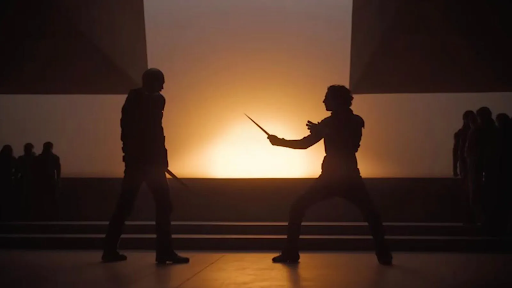
What was imminent was Fraser returning to work on the cinematography for “Dune: Part Two,” and he did an even better job than with its predecessor. The visuals are more stunning with the bold choice of separate color palettes for different planets, black and white for the Harkonnen home planet Giedi Prime, the lush greenery of Kaitain, and of course the endless orange dunes of Arrakis.
Furthermore, the casting was again, perfect, most notably, Butler’s performance of Feyd-Rautha Harkonnen was one of the highlights of the film. It’s hard to even tell Butler is acting as he embodies the creepiness of the character so well.
Zimmer returned to compose the score, nailing it once more, especially helping to sell the dark tone shift towards the end of the film. The Middle Eastern influence is still present in the score for the movie, and just like its predecessor, the story can often be told through sounds and visuals. Most notably in the iconic scene where Paul Atreides leads the Fremen army on an attack on the Emperor’s elite Sardaukar forces, launching the Atreides atomic missiles before calling an army of sandworms.
“Dune: Part Two” is simply one of the greatest films of all time. From the immersive visuals, the moving sound design, to the heartbreaking story. It grabs the audience by the collar and doesn’t let go for the entire 166 minute runtime, making it well deserving of a 9.9/10 rating.
Conclusion
Villeneuve cemented himself as one of the greatest sci-fi directors of his generation. His entire motivation to become a filmmaker was to one day adapt “Dune” and once he was finally given that opportunity, he delivered two fantastic movies. Despite successfully adapting the first novel, Villeneuve isn’t done just yet.
The epic conclusion of the “Dune” trilogy arrives on Dec. 18, 2026. An adaptation of Herbert’s 1969 sequel novel “Dune Messiah,” officially titled “Dune: Part Three.”