
On April 22, senior students shuffled from the Performing Arts Center in drizzling rain to the damp-grassy hill opposite the bus loop. As they huddled together in the dreary setting, speakers addressed the crowd in what would evolve into an hour-long enactment of an impaired driving collision.
Every year, the grim event is hosted for seniors, with the hope of enhancing Central Kitsap High School’s familiarity with the conceivable outcomes of intoxicated driving. Multiple components are a part of the mock crash procedure, including emergency services, tow companies, guest speakers, and student actors. An extensive variety of seniors are nominated to act as the victims and suspects in the crash, enacting a head-on collision on their route home from prom.
“We work with the counselling team and administration to come up with a list of kids who we think might be interested in participating and [be] comfortable with putting themselves out there,” Principal Alex Chertok said. “The goal is for everybody to see themselves in the presentation.”
After drafting, they’re then ordered not to inform fellow students of their commitment, and attend weekly meetings reviewing previous mock crashes. These meetings equip them for the eventual improvising which happens during the event, as no acting is rehearsed. Through the Junior Helpers Plan, which facilitated scheduling for student helpers during preparations, volunteers were deployed to assist with makeup portraying grisly wounds, often coupled by copious amounts of fake blood.

“We meet with the actors and talk about what their roles are going to be,” Mock Crash Director Scott McMinds said. “They have to identify who’s going to be a drunk driver, who’s gonna be [a] distracted driver, who’s gonna die. So it’s tough, but we do a lot of work leading up to it.”
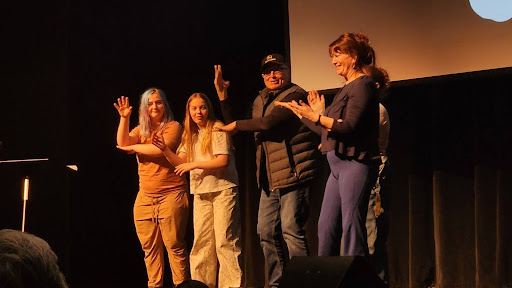
The senior actors worked alongside event directors McMinds and Tyler Hunt to prepare for the annual mock crash. Hunt and McMinds collaborate to ensure every aspect of the operation functions efficiently, planning months to guarantee an immersive experience for the seniors before prom.
“For the last few weeks…we’ve been meeting once a week for every Advisory,” actor David McClain said. “Going over our roles and mentally preparing us for this event. It was a little bit stressful because of the crash that happened with [Olympic High School] a few weeks ago.”
With the onset of rainfall still pouring overhead the collision scene, the operation trudged on. While the realistic nature of the event may have triggered or caused emotional reactions in some, its message was clear. Narration of each facet of the event bolstered the educational aspects and strong messages to viewers, with speakers, as well as first responders describing the work they put into similar occurrences daily.

“I have a couple of kids of my own, and it affects me a little bit when I go to these because ‘man, this could be my kid here,’” Deputy and speaker Brian Haller said. “It affects [me when I’m] going to talk to the parents having to live with that, [me] going to tell them that their kid is no longer here.”
Events and school-based programs such as Drug Abuse Resistance Education and “mock crashes” are shown to be adequate for improving short-term driving behavior and knowledge for teen drivers, but often aren’t able to fully flesh out long-lasting, alcohol-free conduct. Multiple studies show that, alongside programs’ ability to educate students on the results of intoxicated driving, it is beneficial for parents or guardians to also demonstrate responsible driving behaviors. According to the Washington Traffic Safety Reports and National Highway Traffic Safety Administration, half of crash fatalities are caused by intoxicated drivers, with a 16% fatality rate for teen drivers with a BAC of 0.01 g/bL or higher.
“I think [the mock crash] is educating people on what can happen,” senior Haylee Noel said. “I mean, there’s no way to stop someone if they’re going to drink [and drive], but I think it’s a way to show people the effects of it on other people.”
To increase realism, roles included playing students who scream, call 911, pretend to be a drunk suspect, and even blame one another for the incident. These aspects provided a greater authenticity and made it easier for the audience to relate to the crash.
“It’s scary because I was picturing people I know being in that position and how scary it would be for them, their families, and me,” senior Kelsey Kopp said. “I think I would have been careful either way [at prom], but I think that it influenced people I know.”
Through a survey by the American Automobile Association, it was found that 31% to 41% of students at prom said they would likely drink or use drugs that night. Coupled by the fact that roughly 85% of teens say they would rather drive while intoxicated than call their parents, the recipe results in student disaster.
“[High schoolers] are really susceptible to what everybody else is doing at that age,” Kitsap County Sheriff Katherine Weatherwax said. “I think it’s just important to reiterate that message that people are actually dying out there because people are drinking and driving.”

While an estimated 32 people die per day due to drunk driving incidents in the United States, those responsible are not always the worst injured in group accidents. As a result of drinking and driving, there can be multiple criminal charges, including vehicular homicide, which can warrant a sentence of life in prison. An additional two years are added to the original sentence for each previous offense.
“I mean, [my takeaway is] not to do substances,” Noel said. “It’s not even just your choice that can affect someone else, it’s other people’s choices. They choose to drink [and drive].”
One point largely touched upon throughout the presentation was the weight students carry not only on themselves, but on others during impaired driving. As prom season and end-of-year celebrations commence, the mock crash is a stark realization built to drive students towards safety in the coming months, with the single goal of saving at least one life.
“I highly recommend that every school participate,” Weatherwax said. “I know it can be a sensitive subject for the kids watching. I think it’s a harsh reality out there that they’re going to have to face. They’re becoming adults soon, and they need to see this in order to make good choices.”