
St. Michael Medical Center Closed Down its Pediatric Rehabilitation Center, Removing Care for Hundreds of Kids



The Pediatric Rehabilitation Center at St. Michael Medical Center was a facility to provide comprehensive care to children with congenital or acquired disabilities to help improve their mobility, strength, and cognitive skills. Supporting hundreds of children at a time, and having hundreds more on the waitlist, the closing of the center is causing families to disperse in the hopes of finding similar services at different locations.
“[The closing was] very abrupt, very shocking, and honestly scary because my child is on Molina Healthcare, and a lot of the places in the community don’t take Molina,” mother of affected child Shalyn Green-Gaden said. “So that means we’re very limited on where we can receive services again, [it takes] 50 minutes to Gig Harbor or Tacoma or Seattle for services. Right now, the only service that we have lined up for her is OT [occupational therapy] and that’s not supposed to start until June sometime. I still don’t have a start date yet.”
At first, the hospital’s administration didn’t put out any announcement about the closing, but left it to be repeated throughout the day by individual physicians. Many families didn’t become aware of the closing until having an appointment and only when pressured by the media, did the hospital print letters to be placed in the waiting room.
“In April, my kid had tears in her eyes and I started to tear up,” mother of affected child Darci Bassett said. “It was really emotional and really stressful. I think one of the themes throughout this whole experience has been the lack of communication from the hospital. The fact that they didn’t give the therapists anything that they could give to families or any sort of communication…It was just awful.”
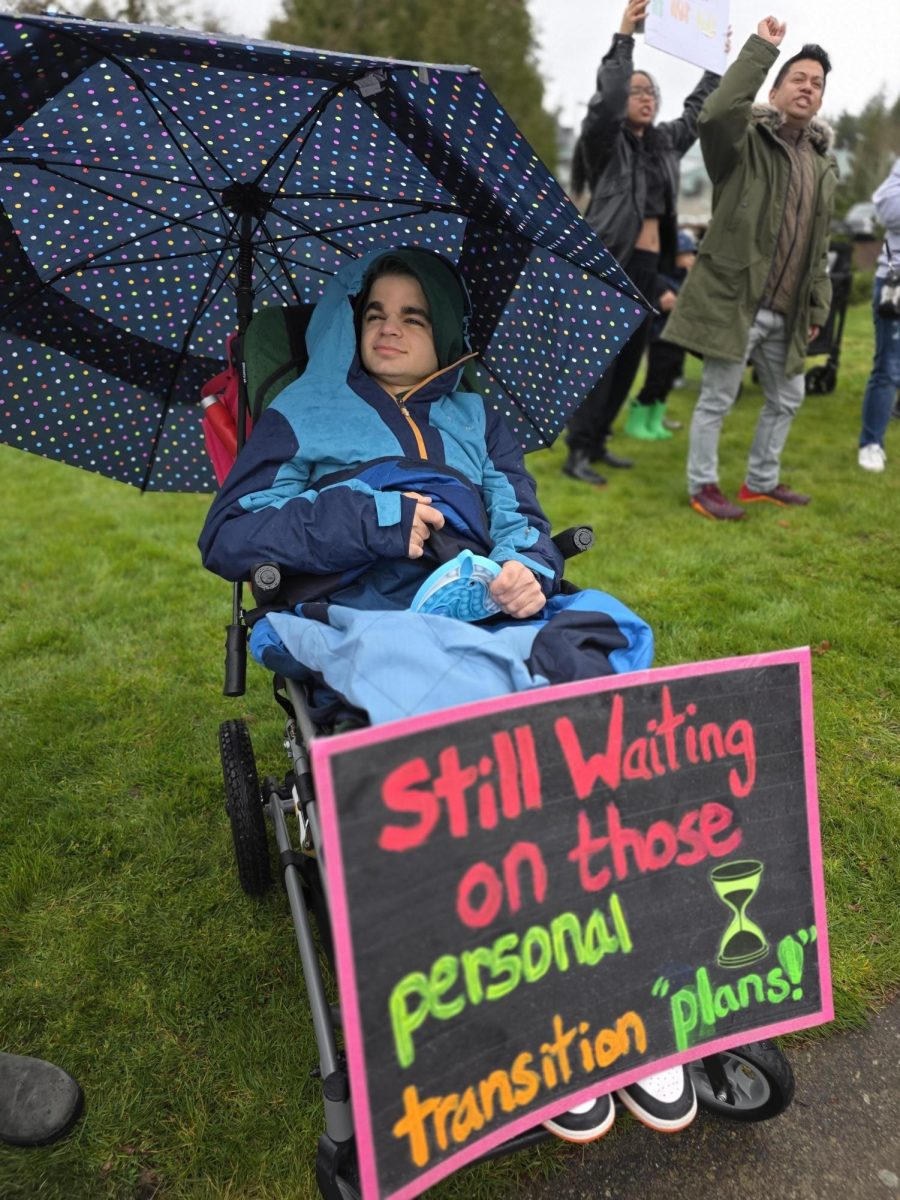
Bassett, along with impacted mother Noelle Pacl, set up a FaceBook group to gather the community of parents and caregivers impacted by the closing to bring attention to the hospital’s disregard for proper communication. Protests and a vigil were organized near St. Michael’s grounds in the hopes of spreading awareness to citizens and hospital administration.
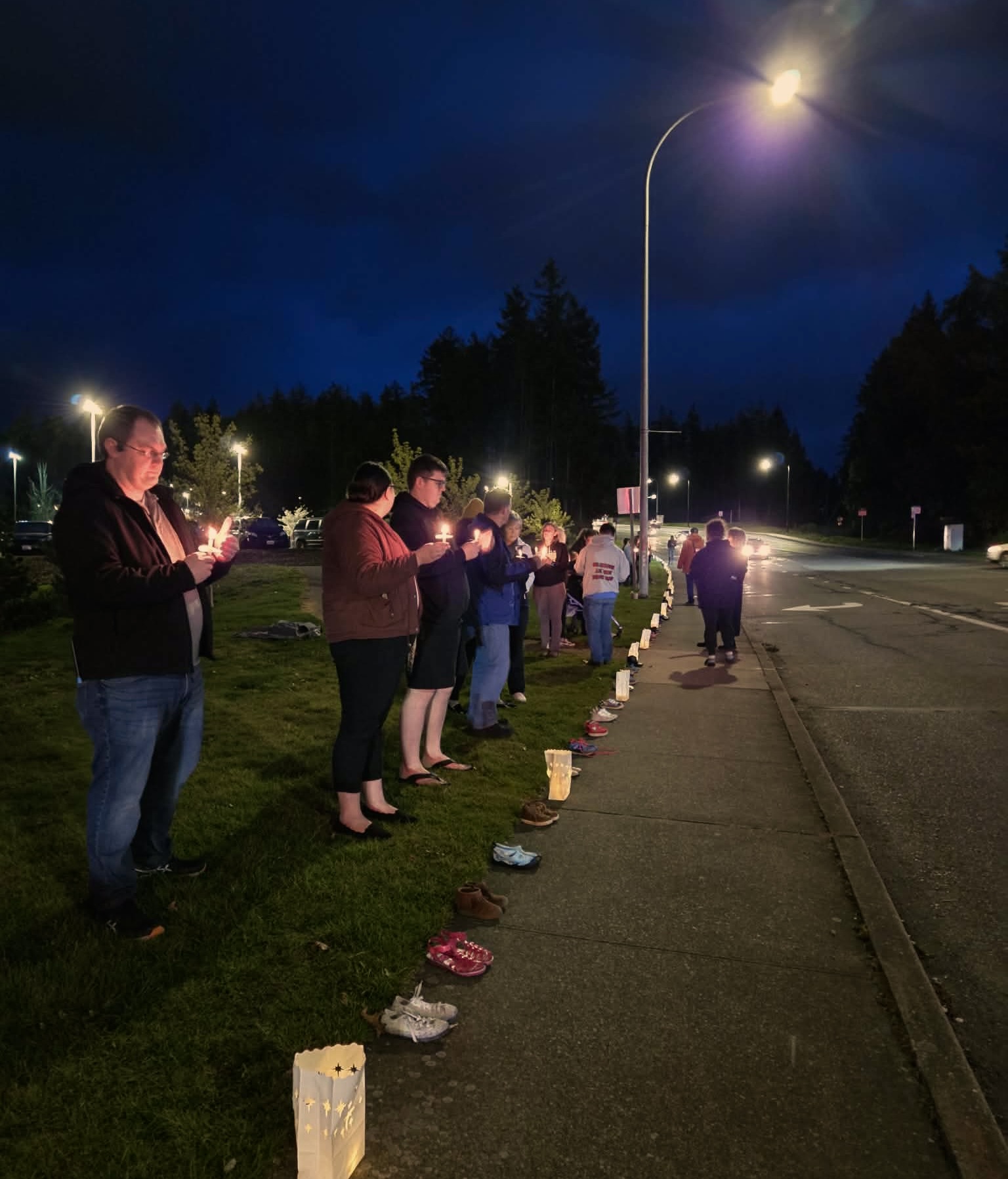
“Exactly a week after the first rally, we held another one [on March 27],” Basset said. “We had about 50 people there and we had members of the community. Then a week after that, on Thursday evening, we did a silent vigil. We lined up 250 little itty bitty shoes on the sidewalk, to provide a visual representation of the scope of this. I think as people, we’re really desensitized to big numbers. But 250 is a lot, and to see all those little shoes lined up, it was emotional for me as a parent and people that came and participated.”
Along with the Kitsap community, local politicians worked with parents to seize the attention of St. Michael’s administrators, whose little communication left parents frustrated and curious about the closing, wondering if there are any solutions.
“We also have gone and participated in several local political meetings, and it was through that process that we connected with Representative Tarra Simmons, [Commissioner] Katie Walters, and a few others who, upon hearing about this and understanding the magnitude of it, have been trying to help us get connected with the hospital,” Bassett said. “That first thought was, if we can just talk to someone at the hospital and understand what’s happening, how they came to this decision, what is the actual deficit, that we could then move forward and find potential solutions.”
When questioned, Chad Melton, Interim Puget Sound President of Virginia Mason Franciscan Health, which is the company that owns the hospital, gave answers concerning financial issues that left parents inquisitive. To help bridge the gap of communication, Representative Tarra Simmons has been working closely with parents in an attempt to meet with the hospital’s representatives.
“Constituents have reached out to me about the concerns, and so I just try convene in some conversations and learn more about the reasoning, but I haven’t been given very clear insight into the decision-making except for what I’ve been told is that they just are kind of running out of money,” Simmons said. “The hospital has told me for a variety of reasons, a combination of different financial circumstances, that reimbursement rates just have not kept up with rising costs of labor, and that the hospital in general has lost a lot of money over the last few years and so they really didn’t give specifics about it.”
On April 3, Simmons officially met with hospital leadership. Despite offering multiple solutions which give parents increased time to switch care providers, none were accepted. The hospital’s financial information was not given, and without the specifics to provide for resources to base their support off of, no financial support could be enacted.
“Representative Simmons [went] into her meeting with the hospital and she directly offered to start making calls to charitable foundations to get the ball rolling for securing funding to keep this open short term,” Basset said. “The hospital did not take her up on any of those offers. She followed up the following week. To my knowledge, she didn’t get any of the financial information that was asked for…We couldn’t take action on any of those [solutions] without real numbers from the hospital. Without actually knowing what the month to month cost is for running the clinic, how much they’re losing, what their billables are, without those details, we couldn’t secure those and we also couldn’t act on behalf of the hospital to accept any of those offers for help.”
During a meeting with the Kitsap County Board of Health on April 7, hospital representatives, and affected parents were held to discuss the children and the outcome of the center closing. Hospital representatives presented on a slideshow, with little of the information pertaining specifically to the hospital or the rehabilitation center.
“Their ‘formal notice’ was giving a generic message to the clinic, and then the clinic handed out to everybody [a flyer], then they finally sent out that same message via mail on the 26th of March, and that was four weeks after we had already found out,” Green-Gaden said. “Then [the Kitsap Public Health Board] sat with us a week before the clinic closed down completely, and the president, Chad Melton, walked out after 30 minutes of the meeting.”
Hospital administrators have kept their distance from parents, communicating to the media early on during the spreading of information towards the shut down. Hundreds of children will have the possibility to struggle with progression in skill as of these few months, but closing down a major medical center in Kitsap will affect thousands. With Kitsap’s large military presence, where many rely on Tricare Insurance, ways to get treatment will be scattered far across Western Washington as services at St. Michael will be lost.
“I feel like the hospital is working really hard to create silos and keep interested parties from being in the same room,” Bassett said. “I feel like there is a reason we are actively going through all of their publicly available financial information. We’re asking people to take a look, because St. Michael’s confirmed in their meeting with the Public Health Board that they are profitable. In this moment, they’re still choosing to cut services like this that directly benefit the health of hundreds of children in our community. It’s not just the 250 receiving services today. As kids do better and graduate and more children move up through the waitlist, this continues to strengthen and support thousands of children over time. And so losing this resource today isn’t just about the kids that are out of luck on Friday [April 24]. It is about the thousands of children that no longer have access to these resources, especially when there’s nothing comparable in our area.”
Parents were given a list of 20 other locations that provide similar care. However, since the list was outdated, parents had to call each individual place to determine whether it still had the services listed and that their insurance would be taken. With a great number of families dividing off from one central point, waitlists at other locations continued to grow.
“In this instance, there is no transfer of care,” Simmons said. “All of this ends for all of our kids on Friday [April 24], and there is no hand-off anywhere. For some of these kids with really medically complex health situations, it’s dangerous. There’s a little girl, she just had surgery in August. She goes to physical therapy three times a week, and the fastest her family can get her into care is a virtual visit in [next] August. The odds of her needing additional surgeries or losing her mobility are through the roof because of this decision.”

On April 13, six parents were invited to speak with five members of the hospital’s leadership staff. Although the meeting was established, the hospital was inconsistent in their initial intentions. As it progressed, during the meeting parents worked to make the administrators feel empathy toward their children’s struggles with the medical complications.
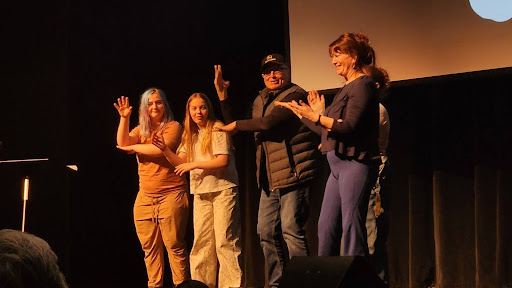
“They invited six moms to participate,” Bassett said. “They said they were keeping it small initially so that it could be [the] solutions [that were] focused [on]. That verbiage shifted throughout the week as they contacted different people. We got in there, there were five members of St Michael’s leadership team present, including the president of the hospital…One of the moms asked everyone there to go through a few really simple exercises. She asked them to touch their nose, she asked them to clap, she asked them to raise their hands, and they were all able to do it without effort. And she said, ‘these are all things that my child has had to work for months to be able to do in physical therapy, and you can do it without even thinking twice.’ After that, they kind of looked at each other uncomfortably.”
In preparation for the meeting, parents sent over a document of their questions and concerns about the Pediatric Rehabilitation Center closing over to the hospital’s leadership team, yet, it was not reviewed. After pressure from the media and local politicians, it is suggested that the hospital’s representatives had the meeting out of obligation.
“The President of the hospital, [Chad Melton], looked at me, he said something to the effect of that they’ve just been in a meeting discussing lessons learned, or things that they’d understood through this process,” Bassett said. “And then he went, ‘We’ll turn the time over to you.’ And I went, ‘You just said, you’ve discussed lessons learned. What have you learned?’ He goes, ‘Well, I guess that’s what I thought we were here today to discuss.’ Once I said, ‘Okay, have you had a chance to review any of the questions?’ He goes, ‘Well, no.’ So we slid our questions across the table. None of them had printed the questions, looked at them, came prepared to speak to any of us, and it became really apparent at that moment that this meeting was being held so that they could say that they had held a meeting. They didn’t anticipate anything productive coming out of it. They had not come prepared. It was incredibly frustrating, especially because for [over] a month, we had been trying desperately to communicate with them to gain some insight and understanding into how this decision came to be, the finances around it, if there were any options for keeping it open.”
The lack of communication persisted over the two months from initial notification. Acknowledgement of such from parents has been met with defiance of publicity. Efforts to seek clarification for the closing deepened the tension.
“I said, ‘who was responsible for…the communication for this entire process?’” Bassett said. “The President of the hospital said, ‘…Well, you know, I’m the president, I guess I take responsibility for that. That would be on me.’ Then he immediately leaned across the table and goes, ‘You’re not recording this, right?’ In the one moment where he took accountability for something, without skipping a beat, his next question was, ‘you’re not recording this?’ As we continued to talk, he became more agitated and frustrated and laid a lot of the blame on lawmakers in Olympia and different bills that have been passed, which was frustrating, and when I asked him for some clarification, he was very quick to tell us that Tarra Simmons had not offered any actual aid or assistance, which we find frustrating because she sent us screenshots of the email she sent [of possible solutions].”
The tone of the conversation shifted to aggression as Melton continued in a state of unrest. Contentious verbal and physical behavior toward the six mothers in the room displayed a remiss regarding their concerns.
“He began to get frustrated that we were pushing back, and he started to get emotional,” Bassett said. “He’s like, ‘this has caused a lot of sleepless nights for me,’ and that was maybe not the right thing to say to six moms who are losing a lot of sleep as we try to figure out how we’re going to care for our kids with very few options. Then he started to get agitated, and he blamed it on lawmakers in Olympia, and he swore twice, pushed himself back from the table, threw down the papers we had given him with the questions, and stormed out of the room.”
St. Michael Medical Center being owned by the corporation Virginia Mason Franciscan Health, also being a subsidiary of CommonSpirit Health, has brought up concern about the possibility of the same vagueness occurring again in the future. The lack of communication and rejection of solutions has stirred up frustration.
“If you’re going to tell us that cuts are coming, and this is what’s going to happen in our community, but you aren’t willing to participate in conversations about it, I find that really problematic from a leadership perspective,” Bassett said. “I was like ‘you told us on Tuesday in that Public Health [Board] meeting that additional cuts are coming. This experience has not been good. I mean, this goes beyond just our kids. We’re concerned as a community. After he left, the rest of the leadership team stayed for the duration of the meeting, and we talked again about avenues for the public to engage with the hospital in making these decisions. And the response was, ‘That’s not possible. These sorts of decisions include confidential information. There really is no way for the public to be involved.’”

Many families have dispersed to similar services in what has only added to pre-existing waitlists. Far travels and uncertainty of care and services can be stressful, especially when coordinating children and parent’s schedules.
“We’re fortunate in that we have private health insurance, even with that, though, we are connecting with Mary Bridge [Children’s Hospital] and the wait lists are really long and the distance is really far,” Bassett said. “With Mary Bridge, the way it works is you go into the waitlist pool and you could be pulled for any of their facilities. So you could get lucky and get Gig Harbor, which is only 45 minutes away, but you could also get pulled for the Renton or a Puyallup facility, or Tacoma. And you don’t really get to indicate preferences because the [demand] is so great. If your slot comes up, they’ll call you and let you know. If you can’t take that slot, then you go back on the waitlist again.”
As different insurance plans and companies largely determine what services are available to families, issues arise in finding adequate care. St. Michael’s being a major medical center in the Puget Sound has left families struggling with transportation, as some of the nearest services are upwards of 45 minutes away.
“Right now I cannot find a physical therapist for my daughter,” Green-Gaden said. “There are maybe one or two clinics that accept Molina, and their waitlist has been backed up for months and months, and they’re not even accepting people on the waitlist right now because of how high everything is. So a lot of us are having to be transferred out to Mary Bridge or Seattle Children’s [Hospital]. Even Mary Bridge [Children’s Hospital], they’re doing evaluations on kids, but then they’re sending everybody out to Renton, so that’s even farther than I can even tolerate traveling with my kid. She’s in school full-time, so that means taking her out of school for her appointments, and it’s just not feasible for all of us.”
The expectation to replicate specialized support without the training or environment of the center displays a long-term challenge for some parents replacing physicians. Although online resources have been given, a permanent fix is yet to arrive.
“I’m not a professional, I didn’t go to school to do what all of her therapists have been doing, so I just try and do everything that I can to keep her active and keep her doing what she was doing,” Green-Gaden said. “I was given resources for YouTube videos to do for speech [therapy], but also she doesn’t tolerate standing in front of something that’s just gonna teach her. She’d rather play, which is what they did at therapy. They did play-based teachings, so it’s very hard to get her to focus for a lot of times [now].”
The decision to close the center was finalized before any notices were given, and explanations were lacking. As a large number of medical centers around the area are owned by the same companies, preventative actions can take place to aid in possible future situations.
“There isn’t really a lot of consolation I can give except for looking at ways to prevent this from happening in the future,” Simmons said. “So I’m planning to convene a lot more healthcare providers to discuss options to prevent this from happening again. So that’s something I plan to do over the next, you know, eight months until we go back to legislative session.”
Claims that Washington state politicians are the cause of the center’s closing are inconsistent with the hospital administrator’s interactions with the public.
“If in this moment, you’re [Melton] blaming lawmakers in Olympia, why aren’t you engaging the public?” Bassett said. “Why aren’t you asking people to get involved, to connect with their senators and representatives, to say, ‘this matters to me?’ Can we work on legislation that builds and supports infrastructure in our community, rather than things that make it more difficult?”
Many types of losses have resulted from the shut down. The physical environment of the center itself, family, and community, have all caused anguish. Although hundreds of children are being directly impacted, it’s thousands of people experiencing the impact.
“There’s been a lot of grief, fear that the kids are going to go backwards because there is not enough services available in our community to take care of these kids and to maintain their therapies,” Simmons said. “So I think the families are very concerned and they’re grieving. Also, this clinic was a special part of their lives for many years in many circumstances. [Now], they don’t know where they’re going to get care. And if they are, is it going to be far away from Kitsap County, in King County or Pierce County and how are they going to get there? Sometimes the kids need services like three times a week. It’s additional travel that means more time off work for the parents and/or the caregivers.”
Your donation will support the student journalists of Central Kitsap High School and help us cover our annual website hosting costs.